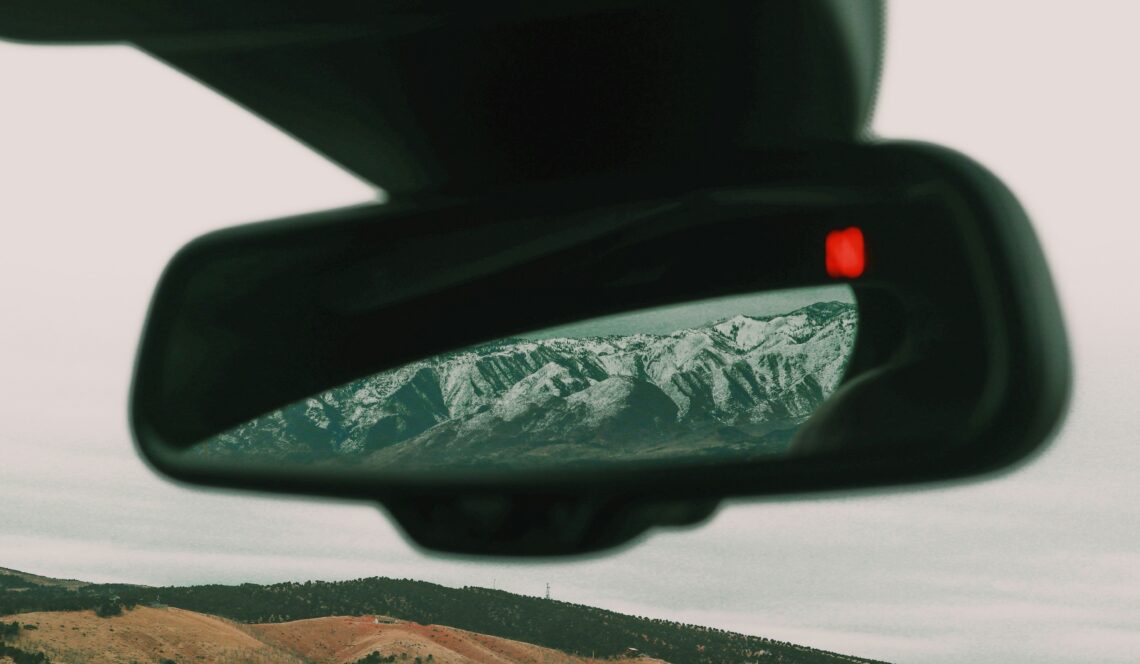
Teachable Travel Moment: Eyes Forward
Nearly two years ago, bored with daily life in the D.M.V., I went in search of roads less traveled. As I’ve racked up miles and memories in two dozen locations, I’ve learned a great deal about the world, life, and myself.
These are my lessons.
#1: You can’t move forward while focused on what’s behind you.
I recently let Google Maps go. In solidarity with hundreds of thousands of users disappointed in Google’s bowing to Trump, I removed the app from my phone. In its place I downloaded MapQuest, whose owners left Lake Ontario’s name unchanged.
Switching to MapQuest was a tiny act of resistance, but it was also a way to pay homage to a company whose print-at-home maps guided me on many a road trip back in the day. Yet as I began using the app, the nostalgia wore off and the technology made me rethink my relationship with the past.
For the most part, MapQuest is fine. Standard turn-by-turn narration and list of directions. However, there’s one feature with a small flaw that’s a big deal to me: I lose my place in the real-time map.
When the map’s up on my center console display, I technically know where I am. An icon representing my car moves along the road. I have a 360-degree view of surrounding streets.
My problem with MapQuest’s point of view is the scale and details. First, one-third of the screen is the road behind you (as opposed to maybe one-fourth on other apps). Second, the rear view has stoplights and stop signs in full color (rather than grayscale). These markers that other apps use as indicators of your upcoming moves, on this app can also represent things you’ve already passed.
For drivers trying to quickly glance at the screen and keep it moving, it’s hard to follow a map in which all things are equally prominent. With no visual separation between what lies ahead and what’s behind, there’s no way to instantly denote the passage of space and time.
The brain can work that way, too. Putting visions of tomorrow side by side with memories of yesterday. Making the past so prominent that you inevitably lose your place and pace in the present as well as your focus on your future.
If the mind were kind, it would live and dream in color but remember in black and white. Or at least have a feature that made our memories less vivid. Confirmation that the moment we’re visualizing is not one we’re reliving. A safeguard against getting stuck in the past.
Instead, our brains are powerful instruments capable of storing a ton of information. The past and the present. The future moments we hope for as well as those we dread. Information that is critical to the story and innocuous details a good editor would cut. It’s all there, jumbled, for us to sort through and make a life.
Thankfully, minds can be renewed in a way that transforms who we are and who we’re destined to become (Romans 12:2). They can be guarded by peace (Philippians 4:7) and directed toward positivity (4:8). They can learn to give eternal truth more prominence than past pain, present challenges, and worries for the future.
The road ahead deserves your greatest attention and therefore, should be the most detailed part of your view. There’s a future full of joy and laughter, love and adventure, and even purposeful pain and growth, all waiting on you.
Set your sights and mind on what is ahead. You have so much to look forward to.
This is the first in a series of posts with lessons from my travels. I don’t know how long it will run. Let’s see where it takes us.

SheryLeigh
SheryLeigh is a woman who loves God, words, and people. She is currently living and loving as an author, blogger, poet, and spoken word artist in the Washington, D.C., area. A communicator by education and trade, SheryLeigh holds a Bachelor of Arts in Journalism from Howard University and a Master of Arts in Management from Webster University.




2 Comments
Tamu
So on time! We can’t change a thing about the past, so we might as well give our full focus to what’s next, strengthening what remains.
SheryLeigh
Amen! Glad to hear it was on time for you.